Canada's 48 national parks protect 340,000 square kilometres of the most extraordinary wilderness on Earth — from the jagged peaks of the Rockies to the ancient fjords of Newfoundland, the tidal marshes of the Bay of Fundy to the polar bear habitat of Wapusk. No country does national parks quite like Canada. The challenge is not finding a great park — it's choosing which one to visit first. This list helps you decide.
1. Banff National Park — Canada's Crown Jewel
Banff National Park
Alberta · Canadian Rockies · Year-round
Canada's first national park (established 1885) and its most visited remains, for good reason, one of the most spectacular protected landscapes on Earth. Turquoise glacial lakes — Lake Louise and Moraine Lake chief among them — sit beneath peaks that rise to over 3,000 metres. Icefields Parkway, the 232-kilometre road connecting Banff to Jasper, passes more than 100 glaciers and is consistently ranked among the world's top scenic drives. Wildlife — elk, grizzly bears, black bears, wolves, bighorn sheep, and mountain goats — is genuinely abundant and frequently seen from the road. Banff townsite has excellent accommodation, restaurants, and visitor services; this is the most developed national park in Canada, and that development is mostly an asset for first-time visitors.
- Iconic photography: Moraine Lake at sunrise (arrive before 6am in summer), Lake Louise at dusk
- Hiking: Plain of Six Glaciers, Sentinel Pass, Larch Valley (September for golden larches)
- Winter: World-class skiing at Norquay, Sunshine Village, Lake Louise Ski Area
- Crowds: Book accommodation 6–12 months in advance for July–August; reservations required for Moraine Lake road access
2. Jasper National Park — Wilder, Quieter, Bigger
Jasper National Park
Alberta · Canadian Rockies · Year-round
Jasper is Banff's less-crowded northern neighbour and, at 10,878 square kilometres, considerably larger. The landscape is wilder and the visitor numbers — though growing — remain much lower than Banff. The Columbia Icefield straddles the boundary between the two parks on the Icefields Parkway and is the largest icefield in the Rocky Mountains south of Alaska. The Athabasca Glacier, one of the icefield's outlet glaciers, can be walked on via guided tours (the glacier has retreated 1.5 kilometres since 1844 — a sobering measure of climate change). Jasper townsite is smaller and more laid-back than Banff, with an excellent dark-sky preserve designation — on clear nights, the Milky Way is visible with the naked eye from the middle of town.
- Wildlife: Jasper has one of the highest concentrations of wildlife-viewing in the Rockies — moose, bears, wolves, caribou
- Icefields Parkway: best driven north to south (Jasper to Banff) in afternoon light
- Stargazing: Jasper Dark Sky Festival in October is world-renowned
- Maligne Lake boat tours to Spirit Island: one of the most photographed scenes in Canada
3. Pacific Rim National Park Reserve — The Wild West Coast
Pacific Rim National Park Reserve
British Columbia · Vancouver Island · Year-round
Pacific Rim is three distinct protected areas on the wild west coast of Vancouver Island — Long Beach, the Broken Group Islands, and the West Coast Trail — united by an uncompromising Pacific Ocean landscape of ancient rainforest, surf-battered beaches, and grey-green sea. Long Beach is the accessible centrepiece: 16 kilometres of hard sand backed by old-growth Sitka spruce, with surf consistent enough to support a thriving surf culture at Tofino. The West Coast Trail is one of Canada's most celebrated multi-day hikes — a 75-kilometre route along a coastline of shipwrecked history, old-growth forest, cable car creek crossings, and suspended ladders on cliff faces that makes it inaccessible for casual hikers but unforgettable for those who complete it. The Broken Group Islands are a sea kayaker's paradise — an archipelago of over 100 islands in Barkley Sound with exceptional camping and wildlife.
- Surfing: Tofino is Canada's surf capital — learn-to-surf schools operate year-round
- Whale watching: grey whales migrate past in March–April; humpbacks in summer
- West Coast Trail: permits required, limited to 60 hikers per day; book months in advance
- Storm watching: November–February, Tofino hotels fill with storm-watchers watching Pacific swells pound the coast
4. Gros Morne National Park — Ancient Earth Exposed
Gros Morne National Park
Newfoundland · Western NL · May–October
Gros Morne is a UNESCO World Heritage Site for reasons that go far beyond scenery, though the scenery is extraordinary. The park's Tablelands feature exposed mantle rock — peridotite brought to the surface by ancient tectonic forces — that provided critical evidence for the theory of plate tectonics. Walking across the Tablelands is, literally, walking on the ocean floor of a 600-million-year-old sea. Beyond the geology, Gros Morne's fjords are among the most dramatic in eastern North America. Western Brook Pond is a landlocked fjord — technically a freshwater lake — whose walls rise 600 metres above the water in sheer cliffs. Boat tours run to the head of the fjord, where waterfalls cascade from the plateau above. The hike to the plateau rim is one of the finest in Atlantic Canada.
- Geology: the Tablelands trail is self-guided and genuinely fascinating
- Western Brook Pond boat tours: book in advance — they sell out in July and August
- Green Gardens trail: coastal hike through sea stacks, sea caves, and meadows
- Getting there: fly into Deer Lake Airport (YDF), 30 minutes from the park entrance
5. Fundy National Park — Tides, Trails and Old Growth
Fundy National Park
New Brunswick · Bay of Fundy · Year-round
Fundy National Park occupies 206 square kilometres of the New Brunswick coast above the Bay of Fundy — a landscape of deep river valleys, old-growth Acadian forest, dramatic coastal cliffs, and tidal flats that twice a day host the world's highest tides. The park has an exceptional trail network of over 100 kilometres, ranging from easy coastal walks to multi-day backcountry routes through ancient hemlock forest. The Coastal Trail offers the most dramatic Fundy views, clinging to the clifftops above the bay. At low tide, the tidal flats are covered in feeding shorebirds during migration — Fundy is one of the most important staging areas for shorebirds on the entire Atlantic Flyway. For broader Bay of Fundy context, our guide to the best scenic drives in Canada covers the Fundy coast route in detail.
- Tidal bore: the park's Alma beach area offers dramatic low-to-high tide transformation views
- Shorebird watching: July–August, thousands of semipalmated sandpipers gather on the mudflats
- Covered bridge driving: dozens of historic covered bridges within 30 minutes of the park
- Camping: Point Wolfe campground is one of the most beautiful riverside camping spots in Atlantic Canada
6. Cape Breton Highlands National Park — The Cabot Trail's Heart
Cape Breton Highlands National Park
Nova Scotia · Cape Breton Island · Year-round
The Cabot Trail runs through this park for its most dramatic stretch — the northern loop where the road climbs and plunges through highland plateau, boreal forest, and clifftop above the Gulf of St. Lawrence. The park's 950 square kilometres protect a landscape that includes the only population of moose to exceed the mainland densities, a genuine highlands plateau above the treeline, and 26 hiking trails from easy to arduous. The Skyline Trail to the sunset headland is justifiably famous; the Franey summit hike near Ingonish is equally spectacular and less busy. In September and October, the hardwood forest turns extraordinary colours against the dark boreal backdrop. This is Atlantic Canada's most scenically dramatic national park.
- Moose: almost guaranteed on the plateau at dawn or dusk — drive the Cabot Trail slowly
- Fall colours: mid-September to mid-October — among the best foliage in Canada
- Camping: Cheticamp, Broad Cove, and Ingonish campgrounds are spectacular; book months ahead
- Golf: Highlands Links at Ingonish is consistently ranked among Canada's top 10 courses
7. Prince Edward Island National Park — Red Sand and Literary Pilgrimage
Prince Edward Island National Park
Prince Edward Island · North Shore · June–October
PEI National Park protects 65 kilometres of the island's north shore — a coastline of red sandstone cliffs, fine warm-water beaches, and fragile dune systems backed by the Green Gables Heritage Place. The ocean here reaches swimming temperatures of 20°C or more by July — the warmest ocean swimming in Atlantic Canada. Cavendish Beach, at the park's centre, is the most famous and busiest. Greenwich, at the eastern section, offers dune boardwalks over parabolic dunes (rare globally), access to the Greenwich Interpretation Centre, and a more tranquil beach experience. The park and L.M. Montgomery's literary landscape are inseparable — the farmhouse that inspired Green Gables sits within the park boundary.
- Swimming: the warmest ocean water in Atlantic Canada — arrive by July for peak temperatures
- Greenwich dune boardwalk: a 4-km interpretive trail over living dunes — no crowds, extraordinary scenery
- Parks Canada Discovery Pass: covers PEI National Park, Green Gables, and dozens of other sites coast-to-coast
- Cycling: the Confederation Trail enters the park at several points — excellent two-wheel access
8. Riding Mountain National Park — Prairie Wilderness
Riding Mountain National Park
Manitoba · Riding Mountain · Year-round
Riding Mountain sits on the Manitoba Escarpment — a dramatic rise from the flat prairie that creates a 300-metre plateau supporting boreal forest, aspen parkland, and grassland ecosystems. The park is Manitoba's finest wildlife watching destination, with populations of black bears, moose, elk, wolves, and bison. A small wild plains bison herd — the most accessible bison herd in a Canadian national park — can be observed from a viewing platform at Lake Audy. The park town of Wasagaming on Clear Lake has a charming retro-resort feel, unchanged since the 1930s, with excellent swimming and boat rentals.
- Bison watching: Lake Audy bison enclosure offers reliable close-range viewing year-round
- Black bear viewing: one of the highest densities of black bears in any Canadian national park
- Wasagaming: the perfect base camp — heritage architecture, good restaurants, beach access
- Off-season: the park is spectacularly quiet in September–October with excellent fall hunting season atmosphere
9. Kluane National Park — Wilderness at the Edge of the World
Kluane National Park and Reserve
Yukon · Alaska Highway · May–September
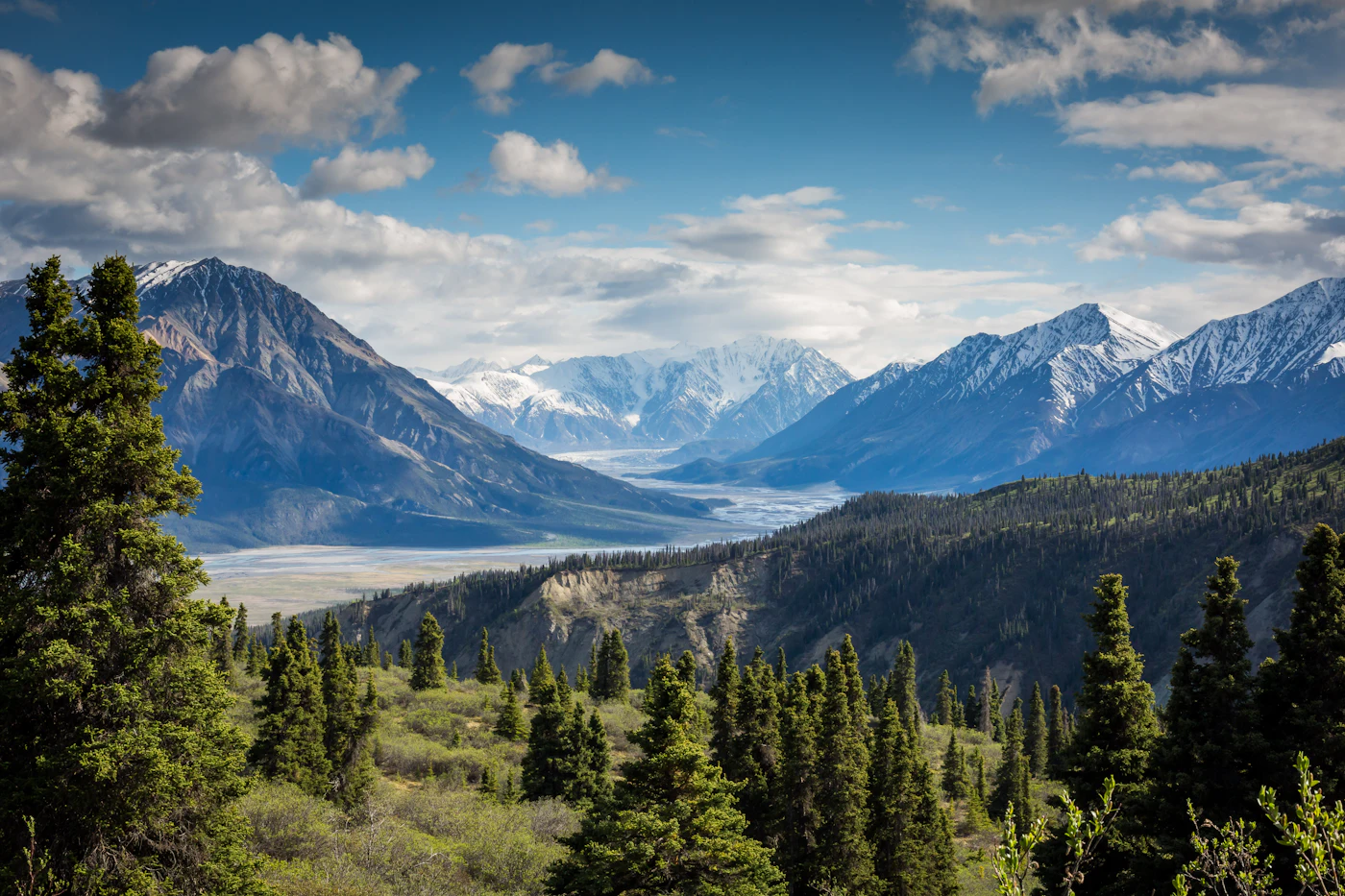
Kluane contains Canada's largest non-polar icefields and the continent's highest concentration of grizzly bears — a landscape of such scale and wildness that it operates on geological rather than human time. Mount Logan, Canada's highest peak at 5,959 metres, sits within the park. Most visitors experience Kluane from the Alaska Highway, where the Kluane Ranges rise dramatically above the road and dall sheep are often visible on the slopes. Backcountry access requires genuine wilderness experience; guided glacier trekking, flightseeing over the icefields, and rafting the Tatshenshini River are the main adventure offerings for most visitors. The park forms part of the largest internationally protected wilderness in the world alongside Wrangell-St. Elias and Glacier Bay in Alaska.
- Flightseeing: glacier and icefield flights from Haines Junction are the most dramatic in Canada
- Tatshenshini River: multi-day wilderness raft trip rated among the world's top 10 river journeys
- Dall sheep: visible from the Alaska Highway roadside — a Kluane signature
- Combine with: Whitehorse, Dawson City, and the Alaska Highway on a Yukon road trip
10. Thousand Islands National Park — The Freshwater Archipelago
Thousand Islands National Park
Ontario · Kingston · May–October
Canada's smallest national park by land area protects a collection of 21 islands in the St. Lawrence River between Kingston, Ontario and the US border — the Canadian portion of the Thousand Islands (there are actually 1,864 islands in total). The landscape is distinctive: pink granite outcrops, ancient white pine and cedar forests, clear green river water, and extraordinary biodiversity in the meeting zone between the Canadian Shield and the Great Lakes St. Lawrence forest region. The park is best experienced by water — kayak and canoe rentals are available at the mainland headquarters in Mallorytown Landing, and the paddling routes between islands are both accessible and spectacular. Sea kayaking among the islands, camping on backcountry island sites, and cliff jumping from the granite outcrops are the defining experiences.
- Kayaking: multi-day island-hopping with backcountry camping — the best paddling in Ontario
- Day trips from Kingston: the park is 45 minutes from Kingston, easily combined with a city visit
- Snorkelling: exceptionally clear St. Lawrence water with submerged shipwrecks visible from above
- Bolt Castle and the castle district: technically in the US, but a Thousand Islands boat tour includes both sides
A Parks Canada Discovery Pass provides unlimited admission to over 80 national parks, national historic sites, and national marine conservation areas across Canada for 12 months. At roughly $75 for an individual or $150 for a family, it pays for itself within two or three park visits. Essential for any serious Canadian park-hopper. Available at any park entrance or at pc.gc.ca.
For more exploration beyond the national parks, our guide to Canada's best hidden gems covers lesser-known destinations that rival the parks for scenery — and are usually empty. For the best roads connecting these parks, see our best scenic drives in Canada.
Discover More of Canada's Best Spots
Get our weekly guide to extraordinary Canadian destinations — national parks, hidden gems, scenic drives, and seasonal picks — delivered free to your inbox.